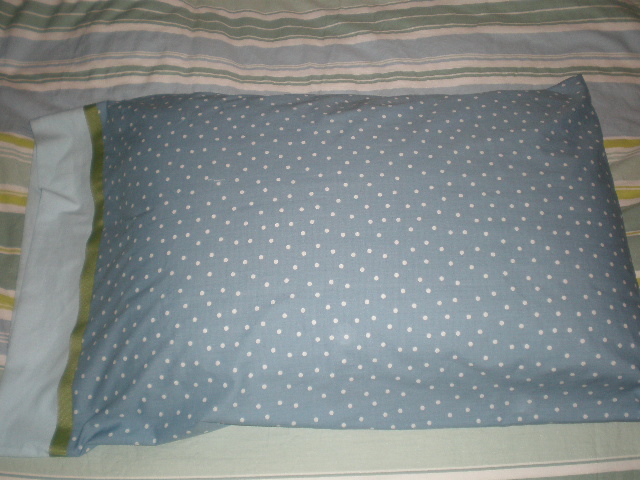
I made the above pillowcase Monday night and wanted to share it with you all.
Materials for 1 pillowcase:
- 1 yard of fabric for main pillowcase
- 1/2 yard of coordinating fabric for end band
- strip of coordinating fabric/ribbon for band transition – 43 inches long and however wide you want (somewhere between 2 – 5 inches would be best).
- If you want 3 inches of band transition strip showing on the outside, cut the piece 3 1/2″ wide to accommodate the 1/2″ seam allowances.
Pillowcase will be sewn using 1/2″ seam allowances.
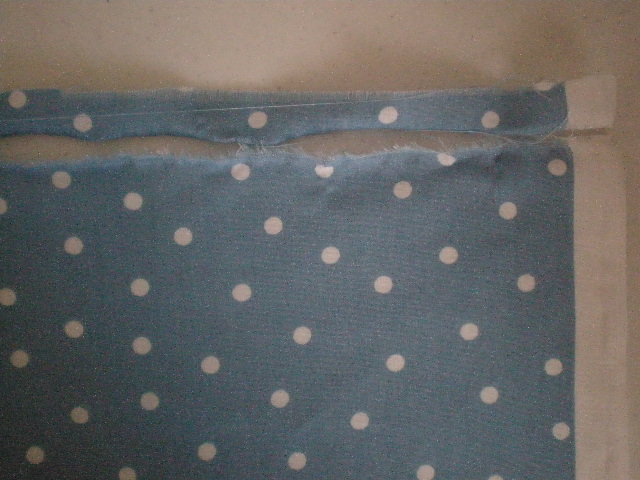
The first thing I do when sewing something, besides preshrinking the fabric using the care instructions on the end of the bolt it came from, is to find the straight grain. It’s impossible to cut fabric exactly straight on the grain and since the people at the fabric store cut it, it’s inevitably cut crookedly. Sometimes my fabric has been cut so crookedly that several inches are wasted. You don’t want to start sewing something using a crooked grain line, so this step is really important.
When you tear fabric, it tears perfectly on grain. Make a little snip, 1/2 – 1 inch, perpendicular to the selvage edge of the fabric and tear it all the way across. Sometimes the grain is off by more than the amount you’re cutting off the top so your strip will come off before you get to the other side. You need to keep tearing a little off the top until your tear travels across the entire width of the fabric.
Once you have torn a strip off the entire top of the fabric, your grain is perfectly straight and you can use the top edge and the selvage edge to line up the fabric to prepare for cutting. The torn edge will be wavy so you can press that edge to smooth things out. Not necessary, but sometimes helpful.
As a side note: not all fabrics tear well, so test on a scrap or just be careful. Also, some fabrics are really messed up and because they have been woven incorrectly do not tear on the straight grain. I bought a piece of flannel that tore at an angle. If that happens, I would suggest taking the fabric back – that is a manufacturing problem. BUT, most of the time tearing is a foolproof and easy way to find the straight grain.